Gemini 2.0 Flash and Why Cheap Models With Strict Prompting is Enough

Gemini 2.0 Flash release and using cheap models with strict prompting for domain tasks like recommender systems instead of paying for frontier models.
In this post
The Gemini 2.0 Flash announcement
Back in December 2024, Google announced Gemini 2.0 Flash. I remember reading the announcement and getting pretty excited about it. Not because it was the most powerful model out there, it was not, but because it’s fast and cheap without sacrificing too much quality. That combination is exactly what matters when you’re building feature that needs to call an LLM thousands of times.
At that time, the Chatbot Arena standings was interesting. Gemini-Exp-1206 was ranked #1 with a score of 1377, tied with ChatGPT-4o-latest. Then Gemini-2.0-Flash-Exp came in at #3 with 1356, above o1-preview. On WebDev Arena, Claude 3.5 Sonnet was leading at 1213 with Gemini-Exp-1206 second at 1017, still above GPT-4o.
This was the moment Google stopped being behind in the LLM race. And they did it with a model family that included a fast, cheap variant that still scoring competitively. Not bad, right?
The principle: strict prompting + cheap models
So at work I was building a recommendation system that needed natural language understanding, analyzing text, matching criteria, scoring relevance. The typical approach would be to throw frontier model like GPT-4 or Claude 3.5 Sonnet at it and just accept the cost and latency. But for a system that process thousands of request, those costs add up fast.
“Do I really need the biggest model for this?”
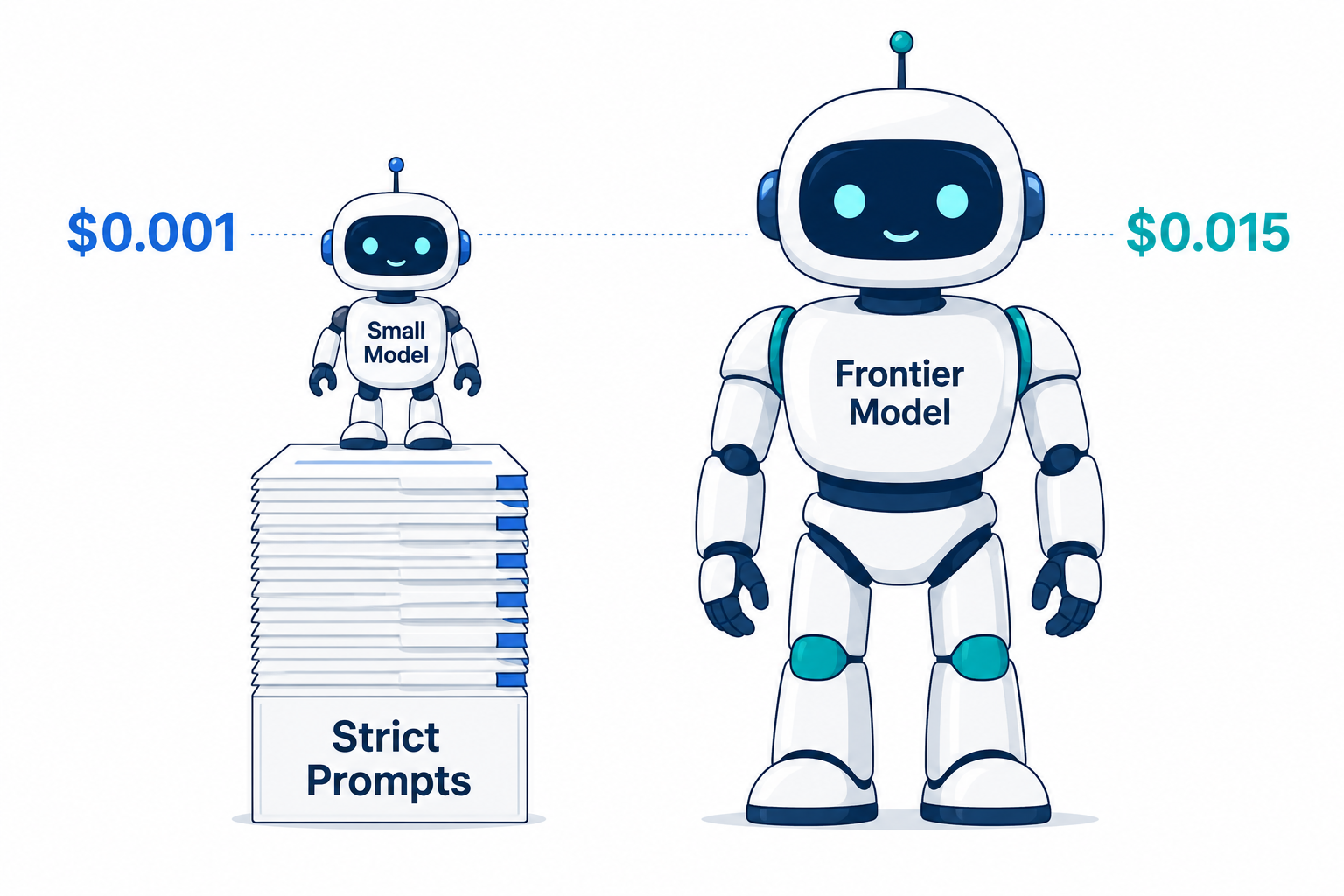
The principle I was betting on: for domain-specific task, a smaller model with strict prompting can match frontier models. What I mean by “strict prompting” is basically giving the model a very structured input format, a clear schema for the output, and constraining what the model needs to reason about. When you do this, even smaller model can produce consistent result because it doesn’t need to do open-ended reasoning, it just need to follow a well-defined process.
Gemini 2.0 Flash was validating this approach for me. A model that costs a fraction of frontier pricing, runs significantly faster, and still sits at #3 on the Arena? That’s the sweet spot for production feature. I was thinking to starting with this kind of model from the beginning because throwing expensive model at everything is just not sustainable when you’re running things at scale.
Why this still matters
The specific model rankings from December 2024 is already outdated. New models come out every few weeks and the leaderboard keeps changing. But the principle is still the same: if your task is well-defined and you can constrain the input and output with strict prompting, you don’t need the biggest model. You need the fastest, cheapest one that can follow structured instruction reliably.
This is not argument against frontier models though. They are still the best choice for open-ended reasoning, creative task, and anything where you cannot fully constrain the problem. But for domain-specific production feature, the cost and latency difference between a Flash-tier model and frontier model is massive. And that difference is what makes LLM-powered feature actually viable at scale, otherwise you’re just burning money for something that a cheaper model with good prompting could handle anyway.
I’m still tinkering around with this approach on different use case and so far it’s been pretty consistent.